

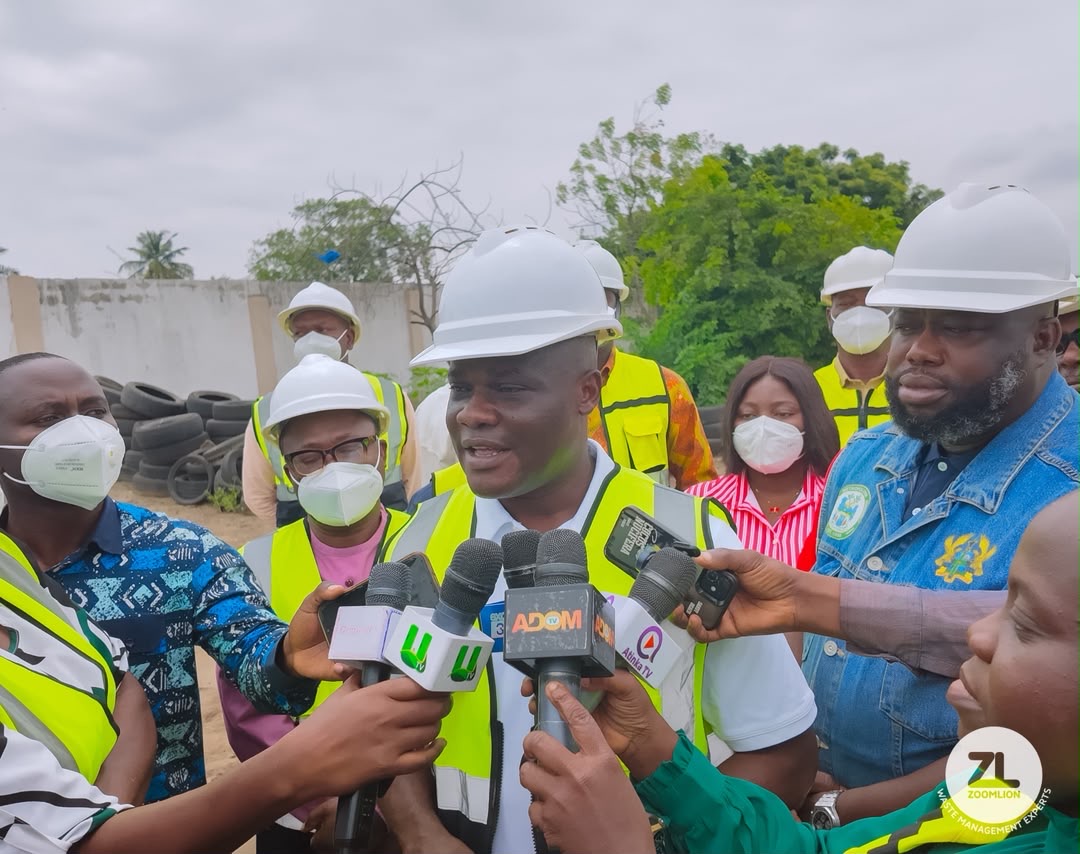
The Minister for Local Government, Chieftaincy and Religious Affairs has announced plans to formalize waste transfer loading stations and integrate tricycle waste collectors into Ghana’s long-term sanitation framework, following an extensive inspection tour of waste management facilities across Greater Accra.
Speaking during a working visit to Zoomlion’s Integrated Recycling and Compost Plant (IRECOP) currently serving as transfer station at Jamestown, the Minister confirmed that five of the six designated waste transfer stations in the capital are now operating at full capacity after government interventions to address the recent accumulation of solid waste in the metropolis.
The operational facilities located at Abokobi, Teshie, Achimota, Ashaiman and Jamestown, were reopened following directives from the President of the Republic of Ghana, H.E. John Dramani Mahama to accelerate waste evacuation. As part of emergency measures, routine administrative procedures, including waste weighing charges at transfer station gates, were temporarily suspended to ensure the swift movement of refuse from communities.
According to the Minister, the intervention was necessary to avert a potential public health crisis following nationwide sanitation exercises, including the recently observed National Sanitation Day, which generated unusually high volumes of waste across Metropolitan, Municipal and District Assemblies (MMDAs).
Despite progress, the Minister noted that the Malam transfer station remains non-operational due to the absence of an accessible road network. He disclosed that National Security, working with the 48 Engineer Regiment of the Ghana Armed Forces, has been tasked with completing the access road to enable the facility to commence operations and ease pressure on existing transfer stations.
The Minister revealed that the Jamestown transfer station alone currently receives waste from approximately 800 of the estimated 4,000 waste-collecting tricycles operating daily within Greater Accra. He described traffic volumes at the facility as a major concern, particularly due to its close proximity to the Korle Bu Teaching Hospital.
To prevent congestion and ensure uninterrupted access for ambulances and other emergency services, the government has introduced a 24-hour operational system at the facility. Under this arrangement, tricycle operators discharge waste during the day, while articulated haulage trucks transport compacted refuse overnight to engineered landfill and recycling facilities in the Eastern Region.
Addressing concerns over the sustainability of the sanitation programme, the Minister defended the Public-Private Partnership (PPP) model, stressing that modern waste management requires significant investment in infrastructure, heavy-duty equipment, fuel, logistics and technical expertise.
He commended the Jospong Group of Companies for responding swiftly to government’s request by providing additional equipment and operational support under credit arrangements, which prevented what could have developed into a major public health emergency.
According to the Minister, the company’s rapid deployment of heavy machinery and long-haul compactors played a critical role in averting widespread environmental and health risks.
The Minister further announced government’s intention to formally integrate informal tricycle waste collectors into the country’s official waste management system. He acknowledged that operators provide an essential service, particularly in densely populated and low-income communities where conventional refuse trucks have limited access.
He disclosed that the Ministry, together with its Chief Director, is developing a sustainable business model that will regularize tricycle collector operations, improve service delivery and incorporate them into the national sanitation framework.
As part of efforts to institutionalize these reforms, the Minister said government will engage the Council of State’s Sub-committee on Sanitation, submit a Cabinet memorandum for policy approval, and work closely with the Ministry of Finance to secure necessary funding for engineered landfill sites and modern waste processing infrastructure across the country.
He reaffirmed government’s commitment to building a cleaner and healthier Ghana, urging citizens, local authorities and sanitation stakeholders to sustain the momentum of the national clean-up campaign. He assured the public that lasting policy, legislative and infrastructure reforms are being pursued to transform the country’s waste management sector.