

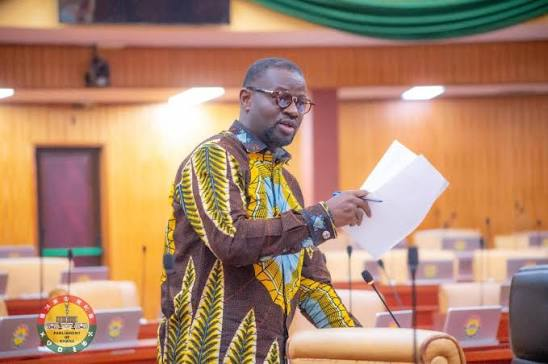

Minority Chief Whip and Member of Parliament for Nsawam-Adoagyiri, Hon. Annoh-Dompreh, has cautioned the government against rushing into carbon credit transactions that could compromise the long-term climate commitments, warning that the country must not sacrifice its future environmental security for immediate financial gains.
Speaking on the floor of Parliament on Thursday during deliberations on Ghana’s carbon market framework, Annoh-Dompreh acknowledged the country’s progress in establishing the Ghana Carbon Market Office under the Environmental Protection Agency (EPA).
He noted that Ghana has taken important early steps to position itself within the emerging global carbon credit market through institutional arrangements that support Article 6 of the Paris Agreement, voluntary carbon market activities, mitigation project development, authorization, monitoring, reporting, verification, registry operations and corresponding adjustments.
According to him, Ghana is not entering the carbon market from scratch. The country has already recorded thousands of climate mitigation activities across the energy, agriculture, forestry and transportation sectors, demonstrating that the necessary foundation has already been laid.
However, he stressed that the next phase must be driven by transparency, strong regulation and policies that inspire investor confidence while protecting the national interest.
Annoh-Dompreh argued that the government must simplify approval procedures, establish clear timelines, maintain transparent regulations and communicate the distinctions between Article 6 transactions, voluntary carbon market projects and domestic carbon activities.
He maintained that certainty in policy implementation would encourage responsible private-sector investment while ensuring credibility in the international carbon market.
The Minority Chief Whip issued his strongest warning when discussing the sale of carbon credits, insisting that carbon assets should not be treated like ordinary commodities.
He explained that carbon credits are directly linked to the Nationally Determined Contributions (NDCs), international reporting obligations, biodiversity conservation, land rights, and the country’s future development agenda.
“We must not sell cheap today what we may need tomorrow to meet our own climate commitments,” he cautioned, emphasizing that every international carbon transaction must preserve the ability to fulfil its obligations under the Paris Agreement.
Annoh-Dompreh also expressed concern about the growing credibility challenges facing the global carbon market, including weak projects, inflated emissions claims, double counting, and poor stakeholder consultation.
He warned that Ghana must resist becoming a destination for low-quality carbon projects merely because investors are seeking easier markets.
According to him, every carbon project undertaken in Ghana must demonstrate genuine environmental integrity, measurable climate benefits, and transparent benefit-sharing arrangements for host communities.
He stressed that communities, farmers, traditional authorities and private landowners whose lands and forests support carbon projects must be fully consulted and adequately compensated.
He further called on government to deliberately build a strong domestic carbon project pipeline by prioritising investments in renewable energy, methane reduction, landfill gas management, regenerative agriculture, forest restoration, mangrove protection, climate-smart irrigation, public transportation, industrial energy efficiency and water purification.
He argued that carbon financing should not only reduce emissions but also create jobs, strengthen food security, support the energy transition, and promote local economic development.
Beyond project development, Annoh-Dompreh advocated significant investment in local expertise to reduce the dependence on foreign consultants.
He proposed the establishment of a National Carbon Finance Academy linked to the Ghana Carbon Market Office, universities, and the private sector to train Ghanaian professionals in carbon accounting, project design, legal contracting, registry management, financing structures, and community benefit-sharing.
He also called for further strengthening of the Ghana Carbon Registry to ensure accurate tracking of mitigation projects, issuance of credits, transfers, retirements, authorizations and corresponding adjustments.
According to him, the registry must be fully digital, transparent, secure and integrated with Ghana’s national greenhouse gas inventory and climate accounting systems.
The Minority Chief Whip concluded by urging stronger coordination among all institutions responsible for Ghana’s carbon market, including the Ministry of Environment, the Environmental Protection Agency, the Ghana Carbon Market Office and the various technical and inter-ministerial committees.
He maintained that only through effective coordination, transparency and strong governance can Ghana fully unlock the economic opportunities presented by carbon markets without compromising its environmental future.
His intervention comes as Ghana continues to position itself as a key player in Africa’s emerging carbon economy, where governments are seeking to attract climate finance while balancing economic growth with long-term environmental sustainability.