

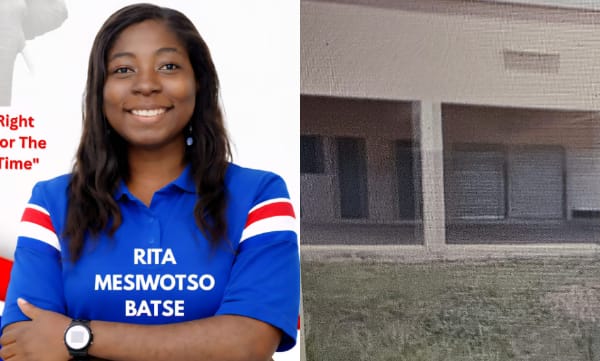

Information gathered has indicated that a New Patriotic Party (NPP) activist in the Hohoe Municipality, Ms Rita Mesiwoto Batse, has been simultaneously invited by the Bureau of National Investigations (BNI) and the Criminal Investigations Department (CID) of the Ghana Police Service concerning an abandoned factory project in the Volta Region.
In a viral video, Ms Batse indicated that the abandoned project, which contains 16 lot Urban Development Grant (UDG) garages project started in 2022 and completed in 2024 under the previous NPP government, is rotting away in the bush.
According to her, these garages could have been used to promote industrialisation and run the government’s 24-hour economy initiative.
These were part of an industrial initiative launched under the previous Akufo-Addo-led NPP government aimed at promoting local manufacturing and job creation.
They were completed garages with ultra-modern washrooms, a creche for working parents, and dedicated fire and police posts.
While details about the specific facility remain limited, such projects were often introduced as part of broader efforts to decentralise industrial development across the country.
However, like many similar projects, concerns are sometimes raised about delays in full operationalisation, maintenance challenges, and funding constraints affecting completion and usage.
It is not also uncommon for newly constructed facilities to require additional infrastructure such as access roads, utilities, and equipment before becoming fully functional, all of which are the responsibility of government.
BNI, CID directed
The BNI and CID invitations to Ms Batse, according to information gleaned, followed a directive from the Hohoe Municipal Chief Executive, Mr Prosper Kumi during a meeting of the Assembly.
This was after the MCE questioned how the NPP activist got access to take pictures and video the rooms in the buildings and their surroundings.
“Let me kindly appeal to the house and the media to be measured in their commentaries because some discussions on our media platforms can either help us or harm us.
“Just yesterday, I came across false information circulating on social media regarding the garages, claiming they had been completed and abandoned. That was very unfortunate. I have since directed my planning officer to engage the security services because we need to understand how an individual managed to gain access to the facility, enter the rooms, and take pictures and videos.
“These are UDG projects and they have not yet been completed. Some essential components were not included initially, so the assembly had to come together to add them before the facility could become operational.
“At the time, the place had no electricity, no water supply, and no access road. All these had to be provided before the project could function properly.
“We must therefore be careful about the kind of information we share on social media and how we go about such matters. I am particularly concerned about how the individual accessed the facility, entered the rooms, and recorded those videos.
“I am therefore putting the security agencies on notice to investigate how the keys were accessed and how entry into the rooms was gained,” the Hohoe MCE directed during the Assembly meeting.
The full details of the invitation of Ms Batse remain unclear, but it is understood that both the BNI and CID are seeking to establish the context in which the video was made, as well as the accuracy of the claims presented.
The development has generated mixed reactions within political and civil society circles in the Hohoe municipality and beyond.
Some NPP supporters argued that Ms Batse was merely exercising her right to free expression by drawing attention to what she perceived as a non-functional public investment.
They insisted that her concerns reflect broader accountability issues regarding the use and maintenance of state-funded infrastructure.
Others have however cautioned against the spread of unverified information, especially on social media, arguing that such content can create misunderstanding about development projects and fuel political tensions.
They maintained that individuals who publicly share information about state infrastructure should ensure accuracy and proper context before publishing content online.
By Kyei Boateng