

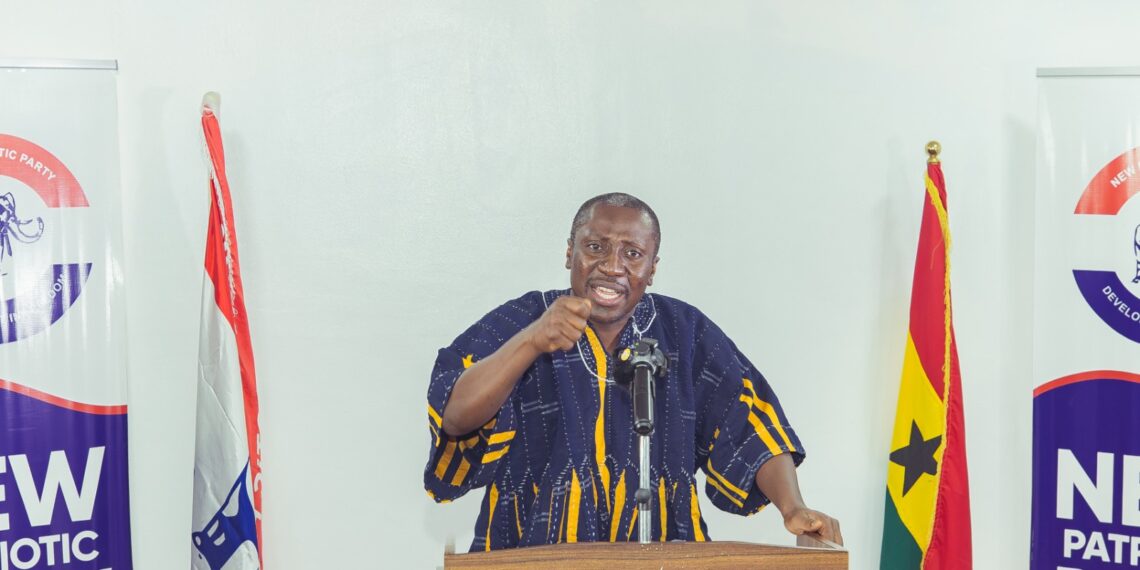

Minority Leader and Member of Parliament (MP) for Effutu Osahen Alexander Kwamena Afenyo-Markin strongly condemned the arrest and remand of Abronye, describing the development as a “constitutional outrage” and a dangerous threat to free speech and democratic governance in Ghana.
He argued that the prosecution and bail denial of the Bono Regional Chairman of the New Patriotic Party (NPP) vividly mirrors the suppression and intimidation associated with the Provisional National Defence Council (PNDC) military junta, which birthed the current governing National Democratic Congress (NDC).
Abronye was arrested and remanded for two weeks by a Circuit Court in Accra under an archaic law, for strongly describing the decisions of a Judge as politically motivated.
Addressing a news conference on Sunday, May 17, 2026, the Minority Leader said the treatment meted out to the NPP regional chairman amounted to political persecution.
He demanded the immediate release of Abronye from the custody of the Bureau of National Investigations (BNI).
He served notice that the NPP legal team will mount a full constitutional challenge to these persecutions, including a challenge to the application of Sections 207 and 208 of Act 29, which are used for the wanton arrest of individuals expressing their opinions.
These primitive provisions, he argued, are against political speech, and civil remedies are available and adequate for individuals who feel defamed.
Bail denial
Osahen Afenyo-Markin also criticised the court’s decision to deny bail to Abronye, describing the ruling as unconstitutional and inconsistent with the principles of liberty and presumption of innocence.
According to him, the prosecution opposed bail on the grounds that Abronye could commit similar offences if released, an argument he said effectively punishes a citizen for what he “might say” rather than what he has been proven to have done.
“A citizen imprisoned not for what he did, but for what he might say. That is not law. That is censorship from the bench,” he stated.
He argued that the charges against Abronye are misdemeanours and noted that the accused has a fixed place of abode, family responsibilities, and identifiable sureties.
The Minority Leader said denying bail under such circumstances undermines Articles 14 and 19 of the Constitution, which guarantee personal liberty and the presumption of innocence.
Call to summon IGP, BNI Director
Osahen Afenyo-Markin also urged the Constitutional, Legal and Parliamentary Affairs Committee of Parliament to summon the Inspector General of Police and the Director-General of the BNI to publicly account for every decision taken in this matter.
“Ghana’s civil society, independent media and legal profession must add their voices now. The time to defend freedom is always before it is fully lost. Never after.
“We call upon the High Court to take urgent cognisance of Mr. Abronye’s detention and the reported absence of a signed and certified remand order.
“The writ of habeas corpus exists for precisely this moment. The judiciary is the last line of defence between the citizen and the unchecked power of the Executive. We call upon it to stand and be counted,” the Minority leader urged.
According to him, prosecuting a citizen over comments made in the public space undermines constitutional freedoms and represents an abuse of state power.
Charges against Abronye
Abronye was arraigned in the Circuit Court 9 in Accra on May 13, 2026, facing two charges under the Criminal Offences Act, 1960 — offensive conduct conducive to breach of the peace and publication of false news.
The charges stem from a social media video in which the outspoken NPP regional chairman criticised a Circuit Court judge and questioned the judge’s impartiality and conduct in the discharge of judicial duties.
Osahen Afenyo-Markin argued that criticism of public officials, including judges, is protected under Article 21(1)(a) of the 1992 Constitution, which guarantees freedom of speech and expression.
He maintained that the prosecution lacks merit and accused the state of attempting to criminalise political criticism.
“Since when did criticising a judge become a criminal offence in Ghana?” he asked.

The Minority Leader further contended that the false publication charge cannot stand unless prosecutors prove that the accused knowingly published false information.
Questions over BNI remand
The Effutu MP raised further concerns about the decision to remand Abronye DC into the custody of the BNI, insisting that the state intelligence agency is not a remand prison facility.
He questioned why a matter involving political commentary had been elevated into what appeared to be a national security issue.
Osahen Afenyo-Markin also pointed out that four days after the remand order was issued, no signed and certified remand order had been made available to the defence team through the court registry.
This, he bemoaned, raises serious legal and constitutional questions about the basis upon which the Ghana Police Service transferred Abronye into BNI custody.
“A remand order is not a verbal instruction. It is a formal judicial instrument upon which the deprivation of a citizen’s liberty must rest,” he stressed.
The Minority Leader warned that if the absence of a signed remand order is confirmed, the detention could amount to an unlawful deprivation of liberty contrary to Article 14 of the Constitution.
‘Government reviving criminal libel’
A major portion of Osahen Afenyo-Markin’s address focused on what he described as attempts by the current administration to revive criminal libel laws through indirect means.
He recalled the repeal of Ghana’s criminal libel and seditious laws in 2001 under former President John Agyekum Kufuor, describing it as a landmark democratic reform championed by former Attorney General Nana Addo Dankwa Akufo-Addo.
According to him, the current administration cannot openly restore criminal libel laws, so it is instead relying on provisions relating to false publication and offensive conduct to target opposition voices.
“The charges against Abronye DC and others are, in substance and effect, criminal libel prosecutions. The only difference is the label on the charge sheet,” he argued.
He accused the government of weaponising state institutions against political opponents and warned against what he termed a gradual return to the “culture of silence.”
Other cases cited
The Minority Leader cited several recent cases involving opposition figures and NPP communicators, including alleged arrests and investigations involving David Essandoh, Baba Amando, Alfred Ababio Kumi (Adenta Kumi), and Assin South MP John Ntim Fordjour.
These incidents, he decried, form part of a broader pattern of intimidation aimed at silencing critics of the government.
“This is state-sponsored political persecution, and it must stop,” he said.
Call to judiciary and civil society
Osahen Afenyo-Markin urged the judiciary to remain independent and resist political pressure, stressing that the courts must serve as guardians of liberty rather than instruments of state power.
He also called on civil society organisations, the media and the legal profession to speak out against what he described as shrinking democratic space.
No return of ‘Culture of Silence’
Osahen Afenyo-Markin warned against any attempt to undermine constitutional freedoms in Ghana.
He said the country fought hard to move from authoritarian rule to constitutional democracy and must not allow political intimidation to erode those gains.
“The culture of silence is not coming back to Ghana. Not now. Not on our watch. Not ever,” he declared.