

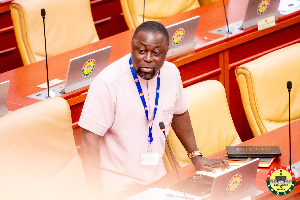

The Member of Parliament for Offinso North, Dr Fred Kyei Asamoah, has made a strong case in Parliament for urgent investment in the Akomadan Irrigation Scheme, describing it as a strategic national solution to Ghana’s growing tomato shortage and food security risks.
Addressing Parliament, the MP emphasized that empowering irrigation infrastructure in Akomadan would enable year-round tomato production and significantly reduce Ghana’s dependence on imports, particularly from neighbouring countries.
According to him, the recent disruption in tomato imports from Burkina Faso has exposed Ghana’s vulnerability and highlighted the urgent need to strengthen domestic agricultural production.
He revealed that in 2023, Ghana produced approximately 468,000 metric tonnes of tomatoes against a national demand of 1,265,000 metric tonnes, leaving a deficit of nearly 60 percent. Despite rising demand, local production continues to decline, a situation he described as unsustainable for the country’s food security and economic stability.
Hon. Fred Kyei noted that Offinso North, particularly Akomadan, has historically been one of Ghana’s major tomato-producing hubs, providing livelihoods for thousands of farmers and traders. However, production remains constrained by seasonal farming patterns and significant post-harvest losses.
Research cited in his statement shows that between 20 and 50 percent of tomatoes produced nationwide are lost after harvest, with losses in Offinso North reaching as high as 42 percent during peak production periods. These inefficiencies, he argued, contribute to sharp price fluctuations experienced across the country.
He pointed out that tomato prices surged dramatically in 2023, reaching about GH¢3,000 per wooden crate for imported tomatoes and GH¢1,500 for locally produced ones during the drought season, while current farm gate prices have risen to about GH¢6,000 per crate.
According to Fred Kyei, the situation demonstrates that Ghana’s tomato challenge goes beyond production and reflects broader systemic gaps in irrigation, storage, and market infrastructure.
Highlighting the potential of Akomadan, he traced the irrigation scheme’s history to developments between 1974 and 1976 under government and World Bank support, which established irrigation infrastructure covering 65 hectares using pump and-sprinkler systems. The facility was later rehabilitated in 2006 and expanded between 2012 and 2013, before transitioning toward modern drip irrigation technology between 2017 and 2018.
Currently, about 624 hectares have been surveyed for irrigation development, with 171 hectares developed, though only a fraction remains fully operational. The MP stressed that expanding and modernising the scheme would unlock massive agricultural productivity in the area.
He further referenced rehabilitation efforts undertaken in 2023 aimed at improving pipelines, storage systems and irrigation chambers as part of a broader plan to help Ghana achieve tomato self sufficiency by 2028.
Calling for decisive action, the MP urged government and stakeholders to accelerate expansion of the irrigation scheme, promote modern irrigation technologies, integrate irrigation with storage and processing facilities, provide farmers with access to credit and inputs, and improve feeder roads to enhance market access.
He maintained that the people of Offinso North are not seeking handouts but opportunities to contribute meaningfully to national development.
“With the right investment, Offinso North can meet Ghana’s tomato demand year round, stabilise prices, create jobs across the agricultural value chain and eliminate reliance on risky cross-border sourcing.”
Dr Fred Kyei Asamoah concluded that rising tomato prices, heavy post harvest losses and challenges faced by traders underscore one clear national priority sustained investment in irrigation driven agriculture.
He said strengthening irrigation systems such as the Akomadan scheme could position Offinso North as a cornerstone of Ghana’s agricultural transformation and food security agenda.