

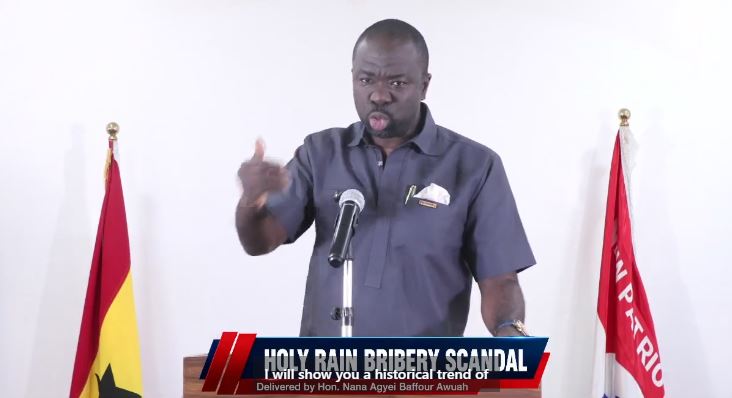
Press Conference By The NPP On The “Holy Rain” Scandal – 11th August 2026
1) INTRODUCTION
Ladies and Gentlemen of the Media, we have invited you today because our nation has once again been confronted with a serious corruption scandal with international dimensions, one that has placed Ghana under an unwelcome spotlight before an international court.
The matter concerns events that occurred during the first administration of President John Dramani Mahama, particularly between 2014 and 2016, at a time when Ghana was experiencing one of the most severe episodes of power shortages in our recent history, popularly known as DUMSOR.
The New Patriotic Party considers it important that Ghanaians understand the facts emerging from the proceedings before the United States courts, the individuals and institutions implicated in the evidence presented, and the steps that ought to be taken by the Ghanaian authorities.
We are not here to prejudge the guilt of any person who has not been convicted by a competent court. We are, however, entitled to ask legitimate questions arising from evidence placed before a foreign court and to demand that the appropriate Ghanaian institutions investigate those matters fully and transparently.
2) THE “HOLY RAIN” SCANDAL
According to the evidence presented in the United States proceedings, a scheme was developed to bribe not only government officials but a relative of President John Mahama in order to push a power plant deal through at the height of DUMSOR when Ghana was desperately seeking additional electricity generation capacity.
One of the emails presented to the jury referred to a Ghanaian official who was awaiting his expected payment as waiting for the “holy rain.” There was, however, nothing holy about those payments. If the expression “holy rain” was used to describe money expected by officials involved in the transaction, then what Ghana witnessed was not a rain of blessings but a rain of corruption, one that threatens to expose the manner in which decisions affecting the national interest may have been compromised for private gain.
More disturbingly, the matter has now become an international embarrassment for Ghana because the evidence was not uncovered through a successful domestic prosecution but through proceedings in the United States. How shameful!
3) THE UNITED STATES CONVICTION
A federal jury in Brooklyn, New York, convicted Asante Kwaku Berko on all counts brought against him, including conspiracy to violate the United States Foreign Corrupt Practices Act, a substantive violation of that Act, and conspiracy to commit money laundering. The verdict followed a nine-day trial before Judge Diane Gujarati. Mr. Berko was remanded into custody pending sentencing and faces potentially substantial imprisonment.
The significance of the conviction for Ghana cannot be overstated. Although the accused person was prosecuted in the United States, the underlying transaction concerned a power project in Ghana, Ghanaian government approvals, Ghanaian public officials and payments allegedly intended to influence decisions of Ghanaian public institutions.
The issue, therefore, cannot properly be dismissed as merely an American criminal case involving an American institution or a foreign commercial transaction. At its core, this is a matter concerning the integrity of Ghana’s public institutions and the protection of the Ghanaian public interest.
4) WHAT HAPPENED? – THE TRANSACTION IN SUMMARY
The evidence before the United States court concerned efforts by Goldman Sachs, acting through its United Kingdom subsidiary, to secure a transaction for its client, the Turkish power producer Aksa Enerji Üretim A.Ş., to build and operate a power plant in Ghana.
For the project to proceed, Aksa required an Emergency Power Agreement and the necessary approvals from several Ghanaian institutions and officials, including the Ministry of Power, Cabinet, the Ghana Grid Company Limited (GRIDCo) and the Public Utilities Regulatory Commission (PURC).
The prosecution’s case was that improper payments were contemplated or made to individuals connected with the approval process. The evidence presented to the court identified several categories of Ghanaian officials and persons connected to the transaction.
So, who are these government and public officials under the NDC government at the time, who were bought? Per the record of the US Court based on which the conviction was made, the government/public officials and close relatives of the President at the time who were involved in the scheme are as follows:

5) THE PAYMENT LEDGER
Ladies and Gentlemen, one of the most disturbing aspects of this matter is the payment ledger introduced into evidence before the United States court. The ledger reportedly contains a breakdown of payments allegedly earmarked for various individuals and institutions connected to the transaction. The relevant entries appear at page 14 of the court record.
Among the entries are amounts associated with Ghanaian public institutions and persons connected to the approval process. These entries cannot simply be ignored. They raise questions that are capable of objective verification through financial records, institutional records, correspondence, procurement documents, meeting minutes and other official documentation.
The NPP therefore believes that the appropriate Ghanaian investigative authorities must obtain and examine the complete court record and trace every relevant payment, beneficiary, intermediary and decision connected to the project.
6) WHAT WAS HAPPENING TO GHANAIANS AT THE TIME?
The timing of these events makes the matter even more troubling. The Ministry of Power was established on 22 November 2014, and Dr. Kwabena Donkor was appointed Minister. At the time, Ghana was experiencing severe and prolonged power shortages.
The Minister publicly committed himself to ending DUMSOR by the end of 2015 and famously placed his position on the line in relation to that commitment.
It was against this backdrop that the transaction under investigation was being pursued. According to the evidence presented in the United States proceedings, on 20 April 2015, an amount of approximately US$500,000 moved from Turkey to Ghana through New York.
On 12 May 2015, the Emergency Power Agreement with Aksa was signed. These dates, viewed against the wider evidence, require careful investigation. While questions concerning payments and approvals were unfolding, ordinary Ghanaians were bearing the enormous economic and social cost of DUMSOR.
The Institute of Statistical, Social and Economic Research (ISSER) estimated that the cost of DUMSOR in 2014 alone was between approximately GH¢320 million and GH¢924 million, representing about 2% to 6% of Ghana’s GDP.
A separate ISSER study involving 885 small and medium-sized manufacturing firms reportedly estimated losses of approximately GH¢250 million during the DUMSOR period. Some 285 firms reportedly ceased operations, with approximately 5,000 jobs lost, while manufacturing contracted by about 2% in 2015.
This is the context in which the allegations must be understood. While Ghanaian households struggled with prolonged power outages, businesses closed, workers lost their jobs and the economy suffered significant losses, there are allegations that individuals connected to the process were seeking private financial benefits from a transaction intended to address the country’s power crisis. That contrast is profoundly disturbing.
What is obvious is that what would ordinarily be concealed by the NDC government through the Attorney General’s filing of Nolle Prosequis, will be exposed on the international plane where there is no NDC government to prevent prosecution or arrange a charade of prosecutions. Hence the lack of deterrence which has not only emboldened persons involved in such corrupt practices but has also led to a pattern of embarrassment on the international plane.
We therefore believe it is necessary to recall some of these instances, not to suggest that they are legally identical, but to demonstrate why Ghana must strengthen its domestic mechanisms for investigating and prosecuting corruption. That requires serious investigation into this latest scandal.
7) A PATTERN THAT GHANAIANS MUST NOT IGNORE
Ladies and Gentlemen, some may be tempted to dismiss this matter as another episode of partisan political disagreement. We urge Ghanaians to resist that temptation. The issue is larger than partisan politics.
What we are witnessing is a troubling pattern in which allegations of corruption involving Ghanaian transactions have repeatedly come to light through proceedings, investigations or settlements outside Ghana. In three of the cases the name of President John Mahama or his relative pops up.
- GHACEM / Scancem. In proceedings before the Asker and Bærum District Court in Norway in 2007, litigation involving Scancem International ANS and its former Africa manager brought into the public domain evidence concerning alleged payment arrangements involving Ghanaian political and party interests during the 1990s. The court’s findings must be distinguished from allegations or evidence that were not adjudicated against particular Ghanaian individuals. Nevertheless, the proceedings exposed issues concerning the movement of funds and alleged political payments under the NDC 1 & 2 administration.
- Mabey & Johnson: On 25th September 2009, Mabey & Johnson pleaded guilty before the Southwark Crown Court in London to corruption offences involving Ghana and Jamaica relating to conduct between 1993 and 2001 under the NDC 1 & 2 administration. The company was fined approximately £3.5 million. The Ghanaian transactions concerned contracts for bridges reportedly worth tens of millions of pounds.
- Armajaro, 2010: The Armajaro matter requires particular caution. Unlike the Mabey & Johnson and Airbus matters, there has not been a court judgment establishing criminal liability against Ghanaian officials in relation to the allegations we refer to here. What is publicly known is that a cocoa-buying company by name, Armajaro, which had faced restrictions in Ghana following allegations of smuggling subsequently had those restrictions lifted, and a British Cabinet Minister reportedly lobbied the Ghanaian Government on the company’s behalf. This was done through a senior Government Official, who was later alleged to be then Vice President John Mahama. In other words, John Mahama as Vice President was lobbied by a British Cabinet Minister to get a reprieve for the ban imposed on Amajaro Holdings, a UK based cocoa buying company that was found guilty for smuggling cocoa out of Ghana, as uncovered by investigative journalist, Anas Aremeyawu Anas. This scandal was revealed by a Report in the British media in 2010.
- Airbus SE. Crown Court at Southwark, 31 January 2020, before Dame Victoria Sharp. The approved Deferred Prosecution Agreement records roughly €5 million in success-based commissions promised or paid to a person the judgment calls “Intermediary 5,” described as a close relative of a high-ranking elected Ghanaian official, over 2009 to 2015, who was referred to as Government Official. The OSP investigated the matter and confirmed the identity of Government Official 1 as President John Mahama. The OSP also established that President John Mahama’s direct involvement in the deal involving his biological brother, had occasioned a breach CONFLICT OF INTEREST RULES. President John Mahama was also implicated by US and UK courts in this Airbus scandal.
- Embraer 190 scandal:- According to Martin Amidu, then as Attorney General, President Mills was compelled to set up a Committee of Enquiry to investigate his Vice President, John Mahama, over his suspicious corrupt conduct in the purchase of 5 aircrafts including Embraer 190 and hanger for the Armed Forces. The committee comprised William Aboah, George Amoah and Brig. Gen. Allotey. John Mahama is the ONLY Vice President in Ghana to be investigated by his President for corruption.
- “Holy Rain Scandal” – We now have the fifth one, being the Asante Kwaku Berko case alias “the Holy Rain Scandal”. This time, it is not merely an allegation contained in a newspaper report or a political statement. A United States federal jury has returned a criminal conviction against Asante Kwaku Berko following a trial. The underlying evidence concerns alleged payments connected to Ghanaian public officials and a Ghanaian power project. This should compel every responsible Ghanaian institution to take the matter seriously.
7) OUR DEMANDS
In view of the seriousness of the matters raised by the United States proceedings and the pattern has been captured above, the New Patriotic Party makes the following demands.
- That Independent Public Inquiry
We call for a publicised, independent inquiry into the circumstances surrounding the Aksa power project and the allegations of improper payments connected with it. The purpose should not be political vengeance but one seeking to unravel the truth, accountability, institutional reform and deterrence.
Through this enquiry, the names and official roles of the persons who handled the Aksa approvals and related processes in 2015, subject of course to applicable legal requirements will be exposed and the extent to which the bribe payment involving the approvals will come to light. The court record reportedly contains payment entries of approximately US$120,000 associated with PURC and US$20,000 associated with GRIDCo engineers. These allegations require immediate institutional clarification.
- Disclosure of the Identity of The “Presidential Relative”
The public enquiry will reveal the identity of the individual described in the United States court record as the “Presidential Relative.”
This is particularly important because the matter raises questions similar to concerns that arose in the Airbus case, where a person described as a close relative of a high-ranking Ghanaian official appeared in the relevant court record.
The Ghanaian public deserves to know:
- Who was this person?
- What was the person’s relationship with President Mahama?
- What company or entity was the person associated with?
- What role did the person play in the Aksa transaction?
- Did the person receive any money?
- If money was received, how much?
- For what service or purpose?
- Most importantly, Ghanaians want to know, why is it always a relative of President John Draman Mahama?
- How his involvement influenced the approval processes?
- The Identity of the so called “MoP GIRLS”
Again, the enquiry will also explain the reference in the payment records to the so-called “MoP Girls.” According to the evidence, US$20,000 out of a promised US$30,000 was allegedly allocated to women described as being important for “communication and information acquisition” at the Ministry of Power.
- Who were these women?
- Were they public servants?
- Were they consultants or private individuals?
- What information were they expected to acquire or communicate?
- To whom was that information to be provided?
- Were any public officials involved?
- And, most importantly, did any public funds or public information become compromised as a result?
These questions deserve clear and evidence-based answers.
- The Attorney-General Must Not Control the Investigation. OSP Must
The NPP also places on record its lack of confidence in the current Attorney-General handling this matter. Since assuming office on 22 January 2025, Dr. Dominic Ayine has been associated with decisions concerning the discontinuance or abandonment of several prosecutions involving persons connected with both the previous and the current NDC administration.
We recall, in particular, the Attorney-General’s entry of nolle prosequi in matters including the SSNIT scandal case, the Saglemi Housing project case, the COCOBOD-related cases and the UniBank case, among others. These decisions have raised serious questions about accountability, the recovery of public funds and the extent to which taxpayers may ultimately bear the financial consequences.
Of particular concern is the UniBank case, which forms part of the wider banking-sector clean-up and involved substantial public expenditure. The Attorney-General has also come under criticism for failing to make critical disclosure before Parliament, especially questions concerning details of the terms of the plea bargain, thereby fueling concerns about transparency and accountability.
Against this background, we do not believe that the Attorney-General can command the confidence of the Ghanaian public to independently investigate or prosecute allegations involving officials or politically connected persons of the NDC. The repeated discontinuance of prosecutions involving persons associated with the NDC administration has created a reasonable perception of selective accountability.
The Ghanaian people deserve an investigation in which they can have confidence—one that is guided not by political affiliation, but by the evidence, the law and the national interest.
9) THIS IS NOT SIMPLY AN AMERICAN CASE
Ladies and Gentlemen, we anticipate that the response from the NDC will be that this is an American case involving an American banker. That response would miss the central point. Yes, the prosecution took place in the United States. Yes, the conviction concerns an individual prosecuted under United States law.
But the underlying transaction concerned Ghana. The alleged payments were connected to Ghanaian public officials. The approvals were required from Ghanaian public institutions. The power project was intended to operate in Ghana. The consequences of any improper conduct were therefore borne by Ghanaians.
The Minister involved was a Ghanaian Minister of State appointed by President John Mahama. The officials associated with the relevant approval processes were Ghanaian public officials appointed by President John Mahama. The institutions whose processes were allegedly compromised were Ghanaian public institutions.
It is therefore misleading to characterise this simply as an American matter. It is, fundamentally, a Ghanaian governance and accountability matter that happened to be uncovered and prosecuted in the United States.
10) CONCLUSION
Ladies and Gentlemen, the NPP is calling for accountability, not selective accountability, not partisan accountability, but national accountability. We are calling for the truth to be established. We are calling for the evidence to be examined. We are calling for every person who may have participated in wrongdoing to be investigated in accordance with law.
We are calling for every innocent person whose name has been brought into the public discussion to be given the opportunity to clear his or her name. And where wrongdoing is established, we demand that the law be applied without fear or favour.
Ghana cannot continue to be a country where allegations of corruption involving Ghanaian public institutions are uncovered abroad while domestic investigations remain inconclusive. We cannot continue to allow the international community to ask questions about Ghanaian corruption that Ghanaian institutions appear unwilling or unable to answer.
The time has come to break this cycle.
The “Holy Rain” case must therefore become a catalyst for a comprehensive examination of the circumstances surrounding the Aksa power project, the individuals involved, the payments allegedly made, and the institutional safeguards that failed.
The Ghanaian people deserve answers. They deserve accountability. They deserve institutions that protect the public interest rather than private interests. And above all, they deserve a government and public institutions that understand that public office is a trust, not an opportunity for private enrichment.
We therefore call upon the Government, Parliament, the Office of the Special Prosecutor, PURC, GRIDCo, the Ministry of Energy and every other relevant institution to act decisively and transparently.
Let the evidence speak.
Let the facts be established.
Let the law take its course.
And let no political party, government official, private individual or institution stand in the way of accountability.
Thank you for your attention.
GOD BLESS OUR HOMELAND GHANA.
GOD BLESS OUR REPUBLIC.
AND MAKE OUR NATION GREAT AND STRONG.