

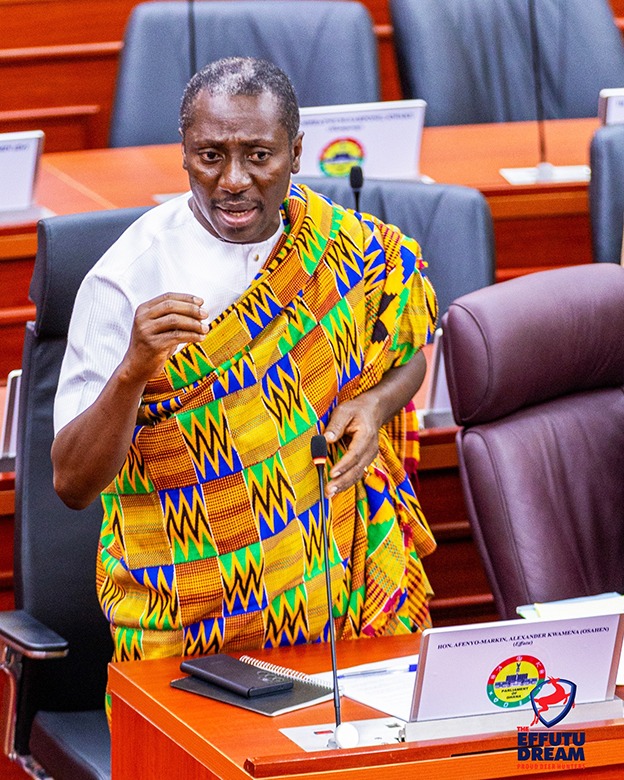

The Minority Leader, Hon. Alexander Kwamena Afenyo-Markin, has called on Ghanaians to change their mindset and attitude, saying the country can only develop when citizens respect state institutions tasked with running social intervention programs.
He made the call while responding to a statement by the Member of Parliament (MP) for Nhyiaeso, Dr. Stephen Amoah, on why Ghana should adopt a mixed market economic policy.
Dr. Amoah had argued that government should introduce intervention policies that allow it to cushion businesses so they can survive.
But the Minority Leader, responding to Dr. Amoah, said the call was a good one but could not work because some Ghanaians lack the attitude needed to make such a policy succeed.
“For us to succeed in implementing this policy, Mr. Speaker, we need attitudinal change. We and our people must change our attitude and our approach,” he said.
He said that over the years, many government intervention programs have failed because people do not place value on state-sponsored support.
“I am aware of many businesses that benefited from state capital injection, and because it was capital from the state, they decided not to pay and they did so with impunity, because there was no power to punish them,” he added.
Citing companies like MASLOC, which was set up by the state to help businesses survive, the Minority Leader said he had personally had to pay off a MASLOC loan owed by certain people in his constituency.
According to him, those constituents had directed MASLOC to him, saying their MP would pay.
“Recently, I had to cough up some GH¢400,000 to pay off a MASLOC loan. When MASLOC reached out to those beneficiaries, they said their MP would pay,” he disclosed.
The Minority Leader said he is “very careful in suggesting a mixed economic policy where the state will set aside funds for the purpose of intervening,” adding that “if we want to be successful in this, then we need to reorient our people.”
He also spoke about the country’s economic problems, saying the solution lies at home, because “the very capital, Mr. Speaker, that we are chasing we call for investments from abroad the money is here, but we abuse it.”